Environmental Storytelling and Design of the Metal Gear Solid Franchise
Intro or something dude idk
The environmental design and mechanics of a video game is a great tool for storytelling. An example of a game, or more so a franchise, that’s environmental storytelling I think highly of is Metal Gear Solid. The franchise is composed of many stealth-action games, and considers itself an “Tactical Espionage Action”. It is best known for its cinematic storytelling, often in the form of movie-like cutscenes. Metal Gear Solid is at its core, a military science fiction story. It explores themes of warfare, genetic engineering, artificial intelligence, identity, and legacy. Each game has a different story, and each story has its own unique different theme.
In this, I will talk about how the environmental storytelling and design of Metal Gear Solid shapes its narrative and affects the gameplay experience and shapes the narrative. For the sake of time and saving writing space, I will only go over Meter Gear Solid 1-3, and MGSV. I wish I could write about the three other games but then this would be almost 10k words long. Admittedly I also don’t consider this an actual “essay”. This isn’t even going to be graded, I already did an essay on Metal Gear in this class two months ago. Think of this as a really bad blog post.
Tech guy in movies (MGS1)


Metal Gear Solid was released in 1998 for the PlayStation (PS1), leaving an influential mark on gaming, applauded for helping popularize the stealth genre and cinematic storytelling. The Metal Gear franchise takes place within a semi-futuristic world where the Cold War had extended into the 1990s, and ended near the end of the century. Metal Gear Solid takes place in 2005. In the game, you play as “Solid Snake”, a legendary infiltrator who had previously gone on missions to stop previous nuclear weapons. And because it is a stealth-action game, you need to try not to be caught by enemies that are guarding the weapon while you are infiltrating the base. (And in the case you do get caught by these enemies, you have to fight them or figure out how to escape.) These enemies also show up on the radar, which its screen would show on the top right hand corner, showing the layout of a room and the movement of enemy soldiers.
It takes the setting of a nuclear weapons disposal facility in a remote island, “Shadow Moses”, in Alaska. Special forces unit FOXHOUND gains control of the island and threatens to use the nuclear mecha REX, and demands a ransom against the US government. Snake is forced out of retirement, and sent to infiltrate the island to stop the threat. He then learns about how he was the product, alongside many others, of the government’s involvement in a cloning project decades ago to create “super-soldiers”.

The storytelling mainly relies upon long, movie-like cutscenes, or codec calls towards radio contacts. But the environment does a lot to assist the narrative too. My top favorite locations in the game overall are the Heliport, Tank Hanger, and Commanders Room. These locations are admirable because its landscapes pretty much set the tone and environment of an infiltration mission in a snowy winter setting. The designers of the game tried to go for a more distinct look for the setpieces, such as adding wear and dirt. This gave the settings more depth and detail, and more closer to lifelike. With every game release, the design, mechanics, and level architecture is always changing. Of the entire franchise, I believe the environmental design of Metal Gear Solid is among the best.
The atmosphere of Metal Gear Solid has always intrigued me since I played it. Many different shades of green and blue. Dark warehouses, underground bases, or caves, and lit up canyons or offices. In the beginning of the game, you’re launched by a submarine to the facility’s indoor Deck. Once you get past that and enter the Heliport, you notice that Shadow Moses is surrounded by dark, snowy mountains. You never really see the outside of the island, and it feels very isolated and closed-in.
And as mentioned before, the Heliport is surrounded by snowy mountains. It’s a dark, and stormy environment. It is guarded by enemy “Genome Soldiers” who patrol around the map. It’s meant to serve as a tutorial for how the stealth-action gameplay works. The location isn't very large, but there's many open areas where you could get caught while running across the map, and many places to hide to avoid getting caught. It’s all to create a sense of suspense and caution.

The Tank Hanger building is right next to the Heliport. In order to get inside, you must climb through a duct and look for an open vent. You enter the Tank Hanger on the top floor, this time giving you a more overhead view of the guards patrolling the scene. The building consists of a variety of floors, and you could better explore the rooms of the floors by going in the elevator.

The Commander’s Room has to be the most visually unique location. Instead of following the green-blue-grey color scheme that's extremely common in the game, the room is covered in a desaturated orange and brown color, with some light yellowish-green lights. It consists of bookshelves, portraits, grand-like furniture and statues. It includes one of the bosses called “Psycho Mantis”, a practitioner of psychokinesis and telepathy. This character basically fits the atmosphere of the room. The way the Commander’s Room is designed creates a sense of eeriness and feel haunting as you’re fighting against a supernatural force.

Compared to the other locations just mentioned, the Communications Tower isn't as appealing in the visual sense, but the layout of the towers does its job well. In the gameplay, the Communications Tower A serves as a major obstacle. After Snake gets caught by a surveillance camera as he’s at the base of the tower, he’s forced to run to the top of the tower while fighting from enemy soldiers chasing and shooting him down, in order to escape the extended chase. It’s composed of a thrilling 27 flights of stairs in a cramped building, and you need to repeatedly spam stun grenades (Grenades that “stun” enemies with a bright light and loud noise) throughout the tower while running up. It’s purposely meant to tire the player, it helps you see the game from Snake’s perspective of how dangerous the mission is, and how much skill or strategic thinking you need to get past.

Metal Gear Solid very often uses colors and the design or layout of locations to invoke a certain feeling in the player, depending on what their objective is or who they’re about to face against when they enter the room. It enhances the gameplay experience, and I think it is very remarkable for what it does. Also I had a lot of fun with the nikita missile
@Grok is this true (MGS2)
3 years after the success of Metal Gear Solid, a sequel to the title was released. Metal Gear Solid 2: Sons of Liberty was released in 2001 for the PlayStation 2, and carried on the stealth-action genres of the previous games.

It starts off with a prologue taking place near New York City in 2007, where Solid Snake infiltrates a tanker that contains the new Metal Gear Model RAY. The ship gets attacked by Russian mercenaries, one of the leaders being a man called Revolver Ocelot, who escapes with RAY. The main story of the game takes place in 2009, and features a protagonist switch where a new protagonist codenamed “Raiden”, an agent in training. The setting is a clean-up facility called "Big Shell”. Raiden is sent on a mission to protect the U.S. president from a group of terrorists. He then learns that he was part of a simulation that was created to test a system that controls human knowledge and actions through AI. He defeats the terrorist leader, while working with Solid Snake.


This time around, the game has massively improved graphics compared to its predecessor. Sons of Liberty plays at 60 FPS (Frames per second), has new game mechanics, and has significantly more detailed environments and objects with higher polygon counts, which was pretty notable for its time. It even had advanced lighting effects, such as shadows, rain, and vertex lighting. While the original MGS game relied on dithering to create textures, MGS2 went for a smoother look.
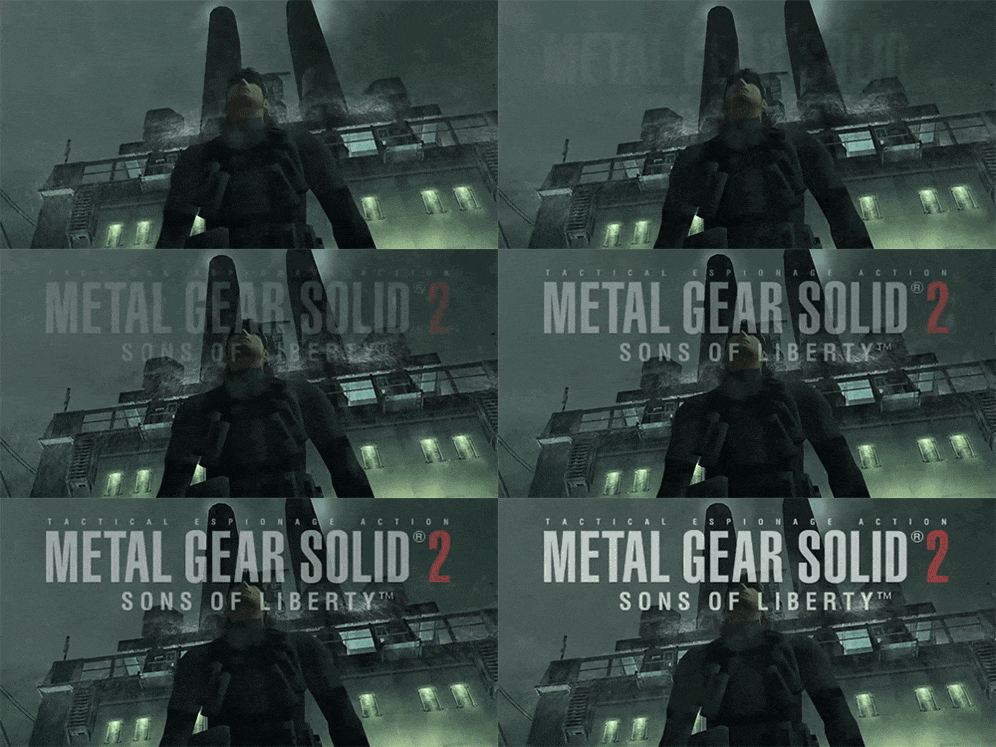
MGS2 introduced new environmental architecture which allowed for new ways for the player to interact in and with the environment. This includes first-person aiming, destroying objects, jumping over obstacles, opening and hiding in lockers, and the ability to hang off ledges. The game had new ways to interact with the enemy soldiers too. This time around, it has a full network of alternative hidden routes. You may go through secret passages, or underground tunnels. All to the advantage < of your infiltration mission.
Sons of Liberty is often described as postmodernist. The themes heavily revolve around artificial intelligence, and the act < of information control by social engineering. The themes of the game are reflected in the setting. Unlike the tanker chapter, Big Shell’s environment is more full of warmth and brightness. It's painted in orange, and is characterized by geometric shapes, each building is actually the shape of a hexagon. The insides of the facility could be described as very structured and symmetrical. This mirrors the themes of the game in the sense that Big Shell is really just a sandbox and a controlled environment for AI experiments. The addition of the orderliness of the location creates an "artificial" setting that very well captures the atmosphere of being in a simulation.


As the game progresses, the game turns darker. More of the truth is revealed, and the facility turns more suspenseful and unsettling as the tone shifts. The final boss fight takes place in the highest location in the game, on top of the Arsenal. The fight taking place on the roof symbolizes the intensity of the climax of Sons of Liberty.

La li lu le lo (MGS3)
Rather than serving as a continuation for the narrative, MGS3 is a prequel to the Metal Gear series. Metal Gear Solid 3: Snake Eater was released in 2004 for the PlayStation 2. It takes place during the Cold War, in 1964, several decades before the first few games of the franchise, and is the chronological start of the overall story. The game is meant to give the early backstory of the “antagonist” (Funny how he’d technically be the antagonist here) of the games and demonstrate the origins of events that occur in the series.


In Snake Eater, you play as the protagonist codenamed Naked Snake, (Yep, that’s actually his name.) (Different guy from the other Snake, by the way. Think about the cloning project that I mentioned many paragraphs ago) who is an operative in the CIA unit “FOX”. Snake is sent on a mission to infiltrate a Soviet jungle to rescue a scientist. A few weeks later, starts Operation Snake Eater, which sends him back to stop Colonel Volgin’s faction, sabotage the Shagohaud nuclear tank, and kill his former mentor that defected to the USSR, “The Boss”. After he confronts The Boss, he finds out that she had used the defection as a cover story and was loyal to America, but would now be seen as a traitor. The Boss left a dying wish regarding her envision of a better world. (This would then on be misinterpretted by her sucessors) Naked Snake is then rewarded with the title “Big Boss”. (You can really tell how creative they are with these character names. Hah)


In the midst of everything, Snake gets constantly followed by fanboy “Revolver Ocelot”, a spy that likes to show off his fun gun tricks and backstabs almost every group he’s worked or affiliated with.

At first glance, the gameplay mechanics and graphics are pretty similar to those in Sons of Liberty. But the biggest change you’d notice is the change in setting. The previous Metal Gear games tended to take place in some sort of technologic facility-like building, and that building would take over most of the map area. The setting is a 1960s Soviet jungle environment, and because of this, the game introduces new stealth techniques for wilderness survival. Such as camouflage, crawling in tall grass to avoid being seen, or climbing up trees if you just happen to feel like doing that.

Taking place before the events of Metal Gear Solid, MGS3 has less developed technologies. The radars of this game were different from the previous ones in the sense that they were unable to show terrain or differentiate between enemy soldiers and animals. It heavily encourages the player to interact with and explore the environment more to understand the layout of a setting and how it worked.
Compared to the previous games (Especially Sons of Liberty), Snake Eater is more “human”. Obviously this is because of the fact that it takes place in the wild instead of a hi-tech facility, but another reason is also because the enemy soldiers do seem more human than before. Players now had different ways to interact with and manipulate enemy soldiers in their encounters. For example, grabbing them for information, eliminating their food resources to lower their stamina, or even destroying their weapons supply. Sometimes, soldiers would have conversations with each other. From chatting about their surroundings, to more personal dialogues, like talking about their families. Even NPCs could be used to the advantage of the themes of a story, who knew.
Soldiers were now subject to the same forces as the player, and held the same human frailties. They’re used as a tool in the game to further the “humanness” of MGS3. The reason why the game is meant to feel more human-like is because while the others games explored themes that were more abstract or technology-based, Snake Eater is a game about people and their personal stories.


Dirt.gif (MGSV/TPP)
I’m going to skip a few games here. MGS4: Guns of the Patriots is a very memorable game (If you count half hour long cutscenes as a game) but I don’t have much to say about it. And honestly I’m not even going to talk about all the stuff that happened in the two decades in between MGS3 and MGSV. I want to bring up MGSV because the game does something really well regarding environmental storytelling that the other games don't do as much.
Metal Gear Solid V: The Phantom Pain was released in 2015, the last released game in the franchise. Its gameplay mechanics, world design, and graphics are often regarded as one of the best among the franchise. The Phantom Pain revolves around the themes of revenge, conflict/loss, and identity. Lots of events happened during the gap between Snake Eater and The Phantom Pain where Big Boss gradually gets more evil. I won’t be going too deep into the details, it’s hard to fill in the gaps when so much happens.


All you need to know is that: After a destructive accident caused by the enemy organization “Cipher”, Big Boss falls into a coma for 9 years. When he wakes up in 1984, he adopts the name “Venom Snake”, and leads the mercenary group taking place on an offshore platform. The “Diamond Dogs”* was founded by Kazuhira Miller alongside Revolver Ocelot, after the destruction of a private military company Kaz had led with Big Boss. Venom Snake goes on missions throughout Afghanistan and Africa. He wants to rebuild his army and seek revenge on Cipher, but then uncovers a plan by Skull Face to create a parasite to eliminate the people of America and distribute nuclear weapons, believing that world peace could be achieved this way by sending nations into a mutual fear of each other. At the end of the game, it is revealed that Venom Snake had not actually been the real Big Boss, but a “phantom” that had undergone surgery and brainwashing to serve as a body double. The real Big Boss is somewhere out there working on his plan to drown the world in warfare forever (What misinterpreting The Boss's will does to a mf)
(*Named after a David Bowie album and title track. This was chosen as the group’s name because of them being “dogs of war”, which is a metaphor for the violent destruction by trained “dogs” during warfare. The “diamond” part symbolizes dead comrades, and turning their cremated ashes into diamonds in order to honor them.)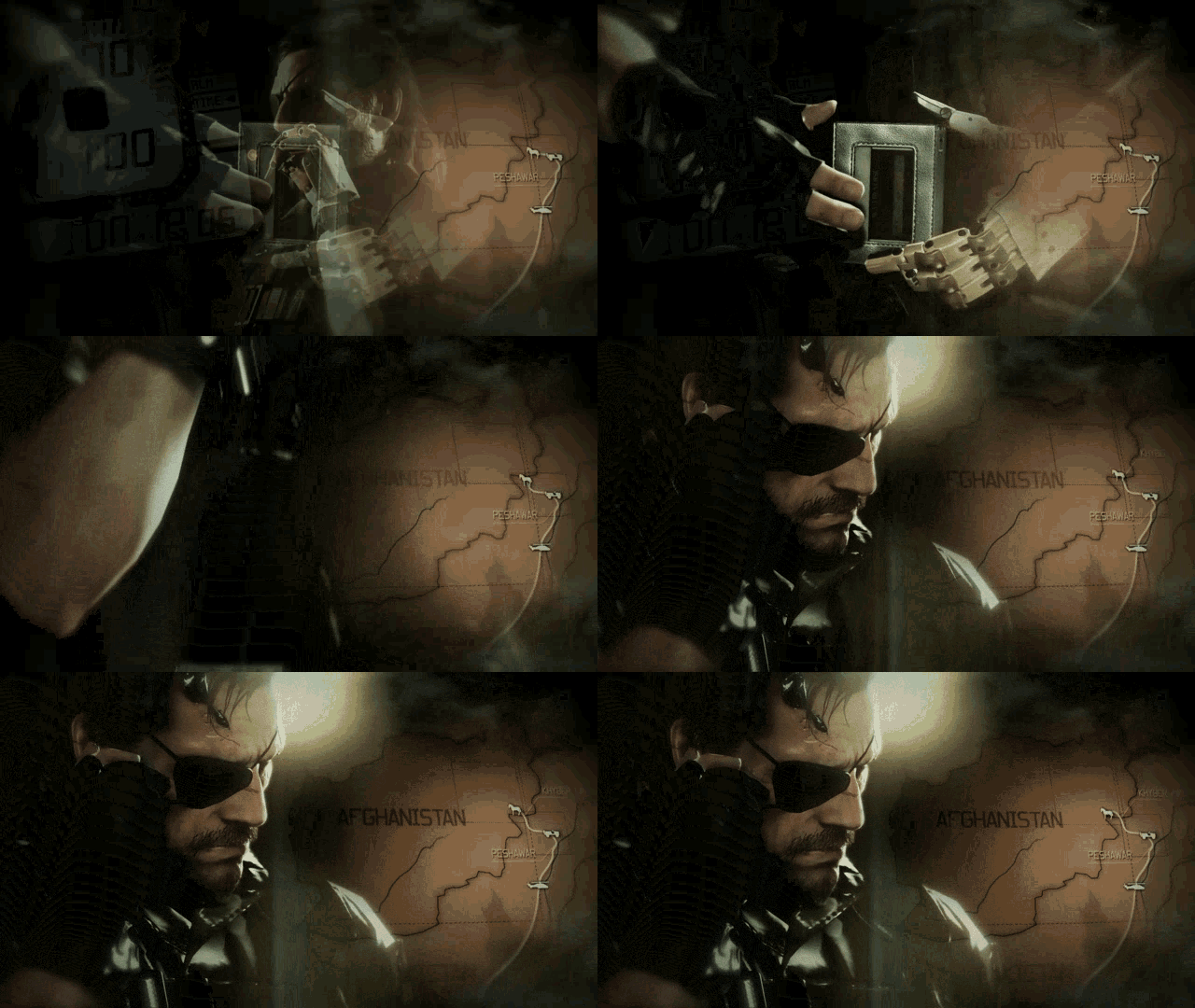
Going back to the topic of gameplay. While the other MGS games were designed with a level system that was typically linear, The Phantom Pain incorporated a fully open world with sandbox mechanics, allowing the player to explore around the entire map with less story constraints.
Linear video games are commonly associated with gameplay limitations. Those limitations are used in order to guide you towards a specific story. They tend to have shorter runtimes, and overly scripted gameplay sequences, generally being more focused on the narrative. Most Metal Gear games were designed linearly, or at least semi-linear with backtracking and some open space.
In comparison, the open-world format for games gives you more freedom and choice. They let you choose your own path and pacing. In addition, they also gravitate towards being more based on exploration and discovery over being narrative-driven. This is the case for MGSV, which takes a massive amount of time to complete. Not only because of how vast many location are, but also because of the amount of missions across the map there are to complete in order to progress the story. This all adds up to a total of 45 to 60 hours of gameplay just for the main story.

The landscapes of MGSV are a favorite of mine. They feel like the environments of Sons of Liberty and Snake Eater merged together. The key locations of the game are the terrains of Afghanistan, the Angola-Zaire border in Africa, and of course the beautifully designed Mother Base, the command center for the Diamond Dogs.
The map of Afghanistan is extremely large. It’s a mountainous and rocky region that inhabits the terrain, Soviet bases, and villages of the Soviet-Afghan war. It’s very detailed, and has a very unique architectural design for its buildings. Adding on to that, the terrain accurately replicates an arid/dryland region. The weather changes, for example sandstorms, helps the player with infiltration.


In contrast, Angnola-Zaire takes place in a sort of jungle (Like MGS3) and swampy region. It’s lesser in size compared to Afghanistan, but offers a more varied environment. Some parts of it could easily be described as damp and gloomy, and at times war-torn, and this lines up with the game’s focus on the cost of war. Both maps contain natural environments and military-occupied areas, and the contrast between them depicts the impact of conflict, and adds to the realisticness of the story.


The Mother Base structure is more similar to the facility of Big Shell from MGS2. They’re both offshore, close in size, follow the same color palettes, and have a modular layout. My personal belief is that it was designed to moderately replicate the aesthetics of Big Shell to create the sense of isolation and that same feeling of the location being artificial and controlled. This mirrors Venom Snake’s story, and also how the recruited soldiers are treated on Mother Base.

The way that Mother Base and the Diamond Dogs look on the surface, may initially just seem like a standard military group at first glance. Soldiers and training and everything. But if you look closer into how it operates, it’s messed up. The game isn’t subtle about its cruelty at all. New soldiers are often recruited through capture and kidnapping. They’re then interrogated by Ocelot, who happily manipulates their state of mind by brainwashing and drugging them. Venom Snake isn’t so great either, he has attempted to recruit child soldiers from Angola-Zaire at some point in the game. They build nukes. A standard military group is bad enough, but this is a war mongering worshipping military company that forces and manipulates you to sacrifice your life and kill innocent people against your will, very akin to a cult.

Mother Base, as I mentioned, is isolated and feels artificial or manufactured. I interpret the isolated and empty feeling of the setting as symbolizing Venom Snake being a “phantom” due to the loss of his identity. His past life was erased from him and now he’s conditioned to look and act as Big Boss. The isolation is also a consequence of his and many other character’s fixation with revenge. Being preoccupied with it disconnects from the world around. The Mother Base giving a sense of feeling artificial and controlled, comes from the fact that down to the core is really just doing that. The recruited soldiers are constantly being brainwashed and manipulated to control their actions.
MGSV allows for many different mechanics for the player to explore and interact with the environment. This kind of interactivity benefits the gameplay and narrative, by making the setting an believable and immersive location. An example of interactivity in the game is base development, in which you gather resources that help in developing equipment and weapons. Another example could be the “Heroism System”, a ranking system that points when completing missions and side ops. The system also works based on Snake’s idea of morality, which further gives the player the sense of acting as him. Although the game’s main story is mostly conveyed through cutscenes, a lot of the worldbuilding and history is revealed through cassette tapes that are scattered around the game, and helps shape the narrative and themes of The Phantom Pain.

Conclusion to my wall of words
Thanks for reading whatever unorganized thing this was. Probably felt weird because of all the stuff I have not mentioned and skipped. I’m too lazy to write a proper conclusion.And my computer is heating up. After I finish this project thing I plan to finally go play Sons of Liberty again after weeks and play with my missiles
